1 / 5
 Dehler
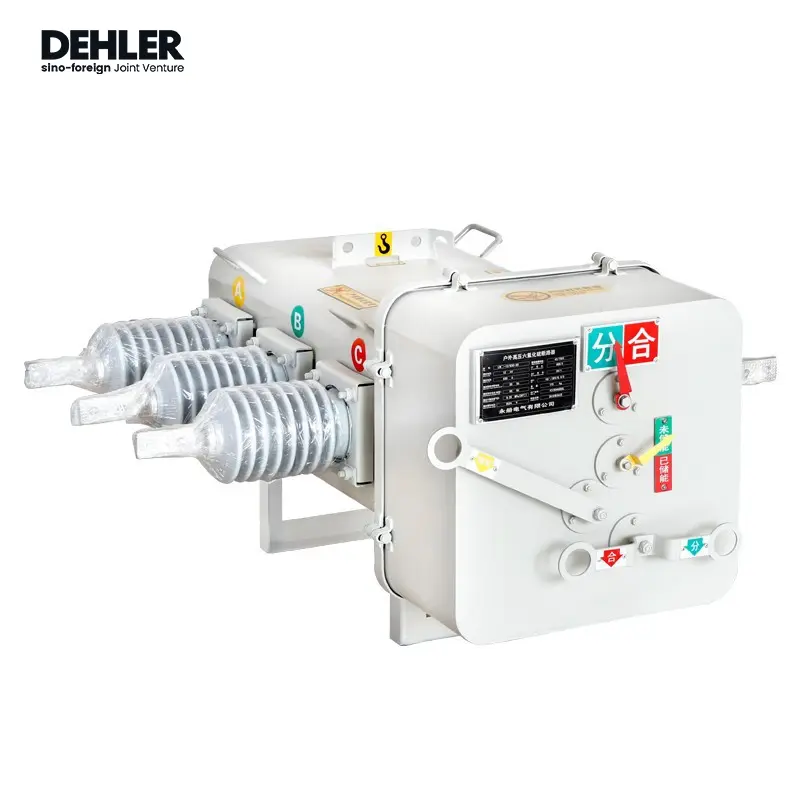
During closing: The operating mechanism moves the moving contact to the left, ensuring good contact with the stationary contact, completing the closing operation.
During opening:
Arc discontinuation: Contact separation generates an arc.
Airflow generation: The moving contact moves the piston, compressing the SF6 gas in the arc-extinguishing chamber, forming a high-speed airflow.
Arc extinguishing: The airflow is blown longitudinally through a nozzle, quickly extinguishing the arc.
Insulation and heat dissipation: The high insulation strength and good thermal conductivity of SF6 gas ensure that breakdown does not occur during or after arc extinguishing, while effectively absorbing and dissipating heat.
Gas circulation: After the arc is extinguished, a portion of the SF6 gas is discharged through the inner hole of the stationary contact and transported to the high-voltage chamber by a gas pump, completing gas circulation and reuse.
Excellent Arc Extinguishing Performance: Effectively extinguishes electric arcs, has a large breaking capacity, and is less prone to reignition when breaking capacitive or inductive currents.
High Insulation Level: The dielectric strength of SF6 gas is 2-3 times that of air, and under certain pressures, it can reach or even exceed the level of insulating oil.
Compact Structure: The high insulation level allows for a reduction in the number of circuit breaker contacts, thus reducing equipment size.
Reliable Operation: Long electrical life, long maintenance cycles, and no fire hazard, suitable for frequent operation.
Primarily used in 110kV and above high-voltage power transmission and transformation systems, such as for the control and protection of transmission lines. It can also be used as a tie-type circuit breaker.
It can also be used in medium-voltage applications, such as for capacitive and inductive loads like capacitor banks, compensating reactors, and motors.